
Onboarding Remote Bookkeepers Effectively
Hiring the right Bookkeeper is only half the journey, the other half is effective onboarding.
A strong onboarding process builds accuracy, trust, and retention from day one.
Whether your Bookkeeper works from LATAM, MENA, or elsewhere, clarity in expectations, tools, and communication defines how quickly they become productive.
Why Onboarding Matters for Remote Bookkeepers
1. Faster Ramp-Up
A well-structured onboarding plan shortens the time it takes for Bookkeepers to handle reconciliations, reporting, and compliance tasks independently.
2. Reduced Errors
Standardized processes lower the risk of reporting discrepancies and missed entries.
3. Higher Retention
Bookkeepers who receive proper orientation and support are 70% more likely to stay with their employer beyond the first year (Simera Talent Benchmark 2025).
🚀 Book a Free Discovery Call to Learn How to Onboard Global Bookkeepers Smoothly
Step-by-Step: How to Onboard Remote Bookkeepers
Step 1. Prepare Before Day One
Before the Bookkeeper starts, ensure:
- Tool access (QuickBooks, Xero, Excel, Drive) is ready
- Financial SOPs are shared (reconciliation steps, month-end process)
- Communication tools (Slack, Zoom, Teams) are configured
- Calendar invites for first-week check-ins are sent
A structured welcome document helps align expectations from day one.
Step 2. Conduct a Role Orientation
Start with a guided walkthrough covering:
- Company overview and accounting policies
- Reporting hierarchy and review cycles
- Tool setup and process demonstration
Bookkeepers in LATAM often appreciate bilingual training materials, while MENA professionals benefit from visual SOPs that outline step-by-step financial workflows.
Step 3. Assign Early Success Tasks
Give new hires manageable but meaningful assignments—like reconciling one bank account or preparing a sample report.
This builds confidence and gives managers an early view of attention to detail.
Step 4. Establish a 30/60/90-Day Framework
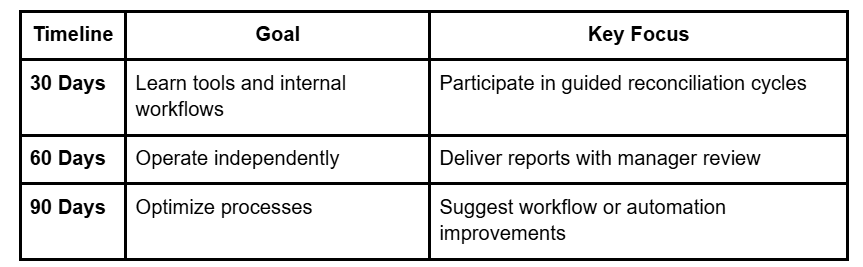
Tracking this progression ensures alignment between performance and company expectations.
Step 5. Create Continuous Feedback Loops
Schedule structured reviews:
- Weekly check-ins (first month)
- Monthly finance syncs
- 90-day evaluation with growth plan
Encourage two-way feedback — ask what could improve their efficiency or clarity.
Step 6. Ensure Security and Compliance
Every onboarding should include:
- Review of data privacy and NDAs
- Access control setup (role-based permissions)
- Secure file storage (Google Workspace, OneDrive, or encrypted systems)
- Password management (LastPass, 1Password)
Security orientation is non-negotiable when handling financial data remotely.
Best Practices for Smooth Onboarding
✅ Use checklists: Maintain a structured checklist for every new hire.
✅ Automate admin tasks: Preload templates, recurring invoices, and report structures.
✅ Encourage collaboration: Introduce Bookkeepers to finance, HR, and ops leads early.
✅ Record sessions: Video walkthroughs help asynchronous learning.
✅ Recognize milestones: Acknowledge 30- and 90-day completions publicly to boost morale.
🚀 Book a Free Discovery Call to Learn How to Onboard Global Bookkeepers Smoothly
Example: Streamlined Onboarding Across Regions
A Canadian e-commerce startup onboarded two remote Bookkeepers — one in Colombia, one in Jordan.
Process Used:
- Standard SOPs in English and Spanish
- Shared dashboards in QuickBooks Online
- Weekly cross-time-zone syncs
Results:
✅ 45% faster onboarding
✅ 99% report accuracy by Week 4
✅ Zero compliance issues after three months
FAQ
Q1: How long should onboarding for a Bookkeeper take?
A: Most Bookkeepers reach full productivity within 2–4 weeks, depending on task complexity and system familiarity.
Q2: What should be included in a Bookkeeper onboarding checklist?
A: Key elements include tool setup, SOP distribution, access permissions, workflow overview, and early task assignments.
Q3: How can businesses onboard remote Bookkeepers across different time zones?
A: Use asynchronous training materials, recorded sessions, and shared documentation to accommodate flexible learning schedules.
Q4: What are the best practices for secure onboarding in finance roles?
A: Implement multi-factor authentication, encrypted storage, NDAs, and restricted system access during setup.
Q5: Why is structured onboarding important for retention?
A: Clear onboarding builds confidence, reduces confusion, and strengthens employee engagement, directly improving retention rates.