

Cost of Hiring a Remote Back Office Team in 2025
As startups scale, back office operations from finance and payroll to admin and reporting become critical. Yet hiring locally in the U.S. or Canada can be prohibitively expensive.
Why Back Office Costs Are Changing in 2025
Global Cost Pressures
The demand for admin, finance, and operations roles has increased by 22% (Simera Global Talent Benchmark, 2025). Startups are shifting to hybrid and remote models to offset labor inflation in North America.
🚀 Book a Free Discovery Call to Estimate Your Back Office Hiring Costs
Remote Hiring as a Strategic Advantage
Hiring globally isn’t just cheaper it’s smarter. LATAM and MENA professionals offer high skill levels, English proficiency, and cultural alignment at 30–60% lower total cost.
Simera’s AI Matching & Payroll Automation
Simera reduces hiring time and total cost by automating vetting, candidate matching, and cross-border payroll. This means startups pay for performance not overhead.
Salary Benchmarks for Back Office Roles (2025)

Source: Simera Global Talent Benchmark 2025
Example: Comparing Total Cost of Ownership
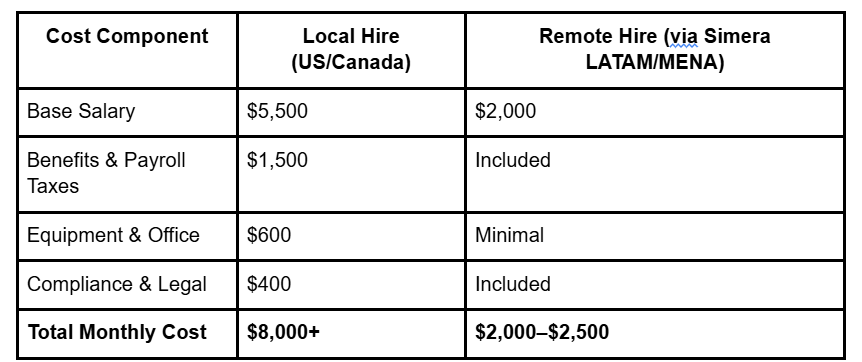
Startups hiring through Simera typically achieve 60–70% savings, with compliant contracts and continuous performance support.
What Drives Cost Differences
1. Labor Market Maturity
LATAM markets like Mexico, Colombia, and Argentina feature mature English-speaking business ecosystems. MENA regions like Egypt, Morocco, and Jordan offer specialized finance and admin professionals with strong process training.
2. Skill Specialization
Specialized skills (e.g., QuickBooks, Xero, ERP systems) raise compensation slightly but still remain far below domestic rates.
3. Employment Model
Costs differ based on hiring model:
- Contractor: Flexible, pay-per-hour or project.
- Employer of Record (EoR): Simera handles compliance, payroll, and benefits.
- Dedicated Seat: Monthly fee covering full-time hire + management support.
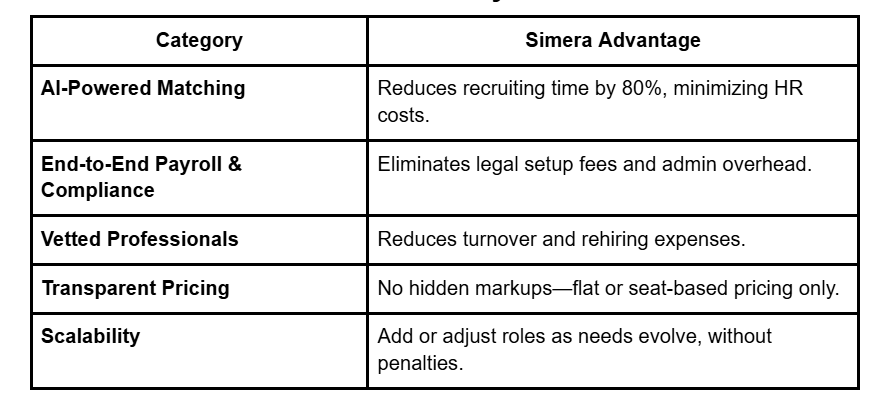
How Simera Reduces Costs Beyond Salaries
💼 Hire Pre-Vetted Back Office Professionals from Our Global Talent Pool
FAQ
Q1: How much does it cost to hire a Back Office professional remotely?
A: Costs range from $1,200 to $2,800/month in LATAM and $1,000 to $2,500/month in MENA, depending on role and experience.
Q2: Are there additional hiring or compliance fees?
A: No. Simera’s flat or seat-based pricing includes contracts, payroll, and compliance.
Q3: Can startups mix talent from LATAM and MENA in one team?
A: Yes. Many companies build hybrid teams to cover time zones and leverage diverse skill sets.
Q4: How quickly can a remote back office team start?
A: Simera delivers vetted shortlists within 72 hours, with full onboarding in 7–14 days.
Q5: What is the average savings compared to local hiring?
A: Startups typically save 50–70% total cost, including salary, benefits, and overhead.


.png)
