The True Cost of Hiring a Remote Accounting Assistant
How much should you budget for a Remote Accounting Assistant? Many companies are surprised to learn that global hiring can deliver up to 60% cost savings without sacrificing accuracy or compliance.
In this guide, we’ll break down what goes into the total cost — from salaries and payroll to management and ROI — so you can make informed, scalable hiring decisions.
Transition: Let’s begin with a clear view of what influences cost the most.
What Determines the Cost of a Remote Accounting Assistant
Several factors shape the total investment:
- Location: Salaries vary across LATAM, the Middle East, and Southeast Asia.
- Experience: Senior assistants with financial analysis or GAAP experience cost more but add strategic value.
- Engagement Type: Full-time vs. part-time vs. contract arrangements.
- Compliance Model: Whether you manage payroll internally or through a provider.
Example: Companies hiring through Simera pay on average $1,500–$2,200 per month, compared to $4,000–$5,000 for local hires in North America.
Transition: Once you understand the drivers, it’s useful to see how regional costs compare.
🚀 Book a Free Discovery Call to Hire Your Next Remote Accounting Assistant
Cost Comparison by Region
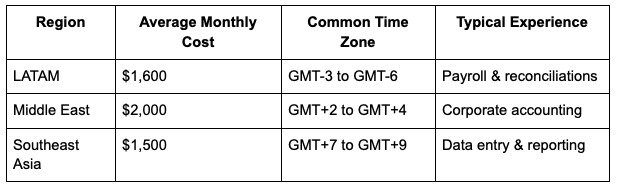
Transition: While salaries form the base, the total cost involves more than just pay. Let’s unpack what’s included.
The Hidden Costs of DIY Hiring
Hiring independently through freelance sites may seem cheaper, but hidden costs often appear:
- Turnover risk: Unvetted freelancers can leave mid-project.
- Compliance complexity: Managing payroll, taxes, and benefits across borders can add 20–30% overhead.
- Time cost: Reviewing hundreds of resumes delays operations.
Simera and Interfell solve these issues by handling vetting, payroll, and compliance, giving companies predictable monthly costs and peace of mind.
Transition: Now, let’s calculate the real return on investment (ROI) from hiring globally.
If you’re evaluating candidates, check out the top tools and skills every remote Accounting Assistant should have 👉 here
Understanding ROI and Cost Savings
When you compare total costs, companies usually save 50–60% with remote hires.
Savings come from:
- Lower base salaries
- Reduced office expenses
- Simplified HR administration
- Scalable, pay-as-you-grow models
Example: A US startup paying $4,500/month locally can hire a vetted global assistant for $1,800/month — saving $32,400 per year while maintaining the same output.
Transition: Beyond financial savings, there’s also strategic value to consider.
Value Beyond the Price Tag
Remote Accounting Assistants often deliver more than just cost efficiency:
- Global expertise in multiple accounting systems
- Round-the-clock support from diverse time zones
- Faster month-end closings through streamlined collaboration
- AI-powered performance tracking for quality assurance
The true cost of hiring a Remote Accounting Assistant goes beyond salary it’s about balancing cost, compliance, and consistency. Platforms like Simera make this balance possible by combining AI-powered vetting, 7–10 day hiring, and full payroll management, giving finance teams reliable global support at a fraction of the cost.
💼 Hire Pre-Vetted Remote Accounting Assistants from Simera’s Global Talent Pool
FAQ
Q1: What is the average cost of a remote accounting assistant?
In most cases, companies pay between $1,500 and $2,200 per month, depending on region and experience level.
Q2: What regions offer the most cost-effective accounting talent?
Regions like LATAM, the Middle East, and Southeast Asia provide skilled accountants at globally competitive rates.
Q3: Are there hidden costs when hiring internationally?
Typically, costs arise from taxes, compliance, or turnover if payroll isn’t managed by a global hiring provider.
Q4: How can companies calculate ROI on remote accounting hires?
Compare total monthly expenses (salary + overhead) to local equivalents many firms save 50–60% annually.
Q5: What payment model works best for remote finance staff?
Most companies use monthly fixed contracts, which simplify budgeting and ensure compliance across regions.