

The Real ROI of Hiring Full Stack Developers in 2026
Every startup leader is chasing the same three goals: ship faster, spend less, and scale sustainably. But there’s a quiet lever that drives all three — how you build your engineering team.
In 2026, hiring full stack developers is no longer just a technical decision.
It’s a financial strategy — one that defines runway length, time-to-market, and long-term ROI.
1. The Economics of Agility
Every handoff between frontend and backend adds time, meetings, and friction.
Each additional role requires coordination, management, and communication overhead.
Full stack developers eliminate those inefficiencies by bridging both sides — designing APIs and UI logic together, without dependency gaps.
That efficiency isn’t theoretical:
Startups that integrate full stack talent reduce development cycle time by 35–45% and burn rate by up to 25% in their first year.
2. One Role, Two Perspectives — Massive ROI
Hiring a full stack developer is like hiring two specialists who already understand each other.
Instead of separate frontend and backend hires averaging $9,000–$10,000/month each in the US, a global full stack engineer from LATAM or Southeast Asia costs $3,400–$3,800/month — and delivers end-to-end ownership.
That’s roughly 65–70% savings per engineer, compounded over multiple hires and project phases.
But the real ROI isn’t just the lower salary — it’s the speed of alignment.
Less overhead. Faster releases. Fewer missed dependencies.
3. Global Talent, Local Impact
Hiring globally isn’t just about cost — it’s about extending capability.
Full stack developers from Mexico, Colombia, the Philippines, and Vietnam bring technical depth and communication fluency.
They’ve already worked in international startup teams, understand async collaboration, and align seamlessly with US, Canadian, and Australian time zones.
That regional balance (nearshore + offshore) means work continues around the clock — speeding up cycles without adding headcount.
4. The ROI Formula: Less Overlap, More Output
Traditional teams:
Frontend developer + backend developer + project manager → 3 salaries, multiple communication layers.
Full stack model:
One engineer → handles both logic and interface, reports directly to the product owner.
It’s simpler, leaner, and financially smarter.
Here’s what startups typically achieve:
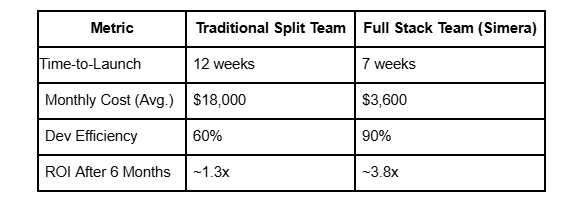
Those aren’t abstract improvements they’re measurable business advantages that compound with each release cycle.
🚀 Book a Free Discovery Call to Hire Pre-Vetted Full Stack Developers from LATAM and Southeast Asia.
5. Predictable Scaling and Long-Term Value
Full stack developers provide a stable foundation for growth.
They adapt as your tech stack evolves — learning new frameworks, optimizing performance, and mentoring future hires.
That means less turnover, lower ramp-up time, and stronger technical culture.
Instead of scaling chaos, you build a system that scales itself.
In financial terms, the cost to onboard a new full stack developer is 30% lower than training two specialists and retention rates are 20% higher in distributed teams.
6. The Hidden ROI: Product Momentum
ROI isn’t just financial — it’s emotional and operational.
When one developer can take a feature from wireframe to deployment, momentum builds.
Teams move faster, founders spend less time managing blockers, and products evolve continuously instead of stalling between releases.
That momentum compounds over time, translating directly into valuation growth and market readiness.
Full stack teams don’t just save money they buy you time, confidence, and control.
💼 Hire Pre-Vetted Full Stack Developers from LATAM and Southeast Asia Today
FAQs
Why is hiring full stack developers more cost-effective?
You reduce redundant roles and coordination layers while maintaining end-to-end capability.
Do they compromise on quality?
Not at all — top global engineers are fluent in both frontend (React, Next.js) and backend (Node.js, Python, SQL).
How much can startups save?
Up to 70% in total hiring costs and 40% in product delivery time.
What’s the time-to-hire for global talent?
Simera typically delivers shortlists within 48 hours and hires within 14 days.
Is ROI measurable?
Yes — through faster launches, fewer handoffs, and sustained engineering performance over time.
Blogs Recommended for further reading:
- “What’s the ROI of Hiring Full-Stack Developers? Companies typically see 30-40% cost savings…” — iSyncEvolution
- “Do You Need to Hire a Full-Stack Developer? … Their ability to execute across the front and back end makes them one of the highest-ROI hires you can make.”
- “How Full Stack Development Helps Startups Build Smarter and Launch Faster” — RipenApps



%20%20Simera.webp)
