

U.S. vs South east Asia Logistics Dispatcher Salary Comparison 2025: Cost Structures, Output Quality, and ROI
The demand for skilled Logistics Dispatchers continues to rise as companies scale e-commerce, last-mile delivery, and trucking operations. In 2025, U.S. companies increasingly hire dispatchers from Southeast Asia due to strong English skills, reliable communication, and significantly more efficient salary levels.
This guide breaks down salary differences, skill parity, output quality, and ROI models so you can make informed hiring decisions.
Interlinks included:
- How to Hire a Logistics Dispatcher from Southeast Asia
- The Best Southeast Asian Countries for Logistics Dispatchers
- What a Logistics Dispatcher Actually Does
- The 2025 Logistics Dispatcher Skills Benchmark
Why U.S. Dispatcher Salaries Continue to Rise
Logistics is becoming more complex and communication-heavy. U.S. dispatcher salaries increase due to:
Key U.S. cost drivers
- High demand for multi-route, multi-driver coordination
- Increased ETAs + customer communication expectations
- More complex tools (TMS, GPS systems, load boards)
- Need for rapid, real-time decision-making
- Labor shortages in transportation support roles
This drives many companies to look globally for dispatcher talent.
Salary Comparison (Monthly)
U.S. vs Southeast Asia Salary Ranges
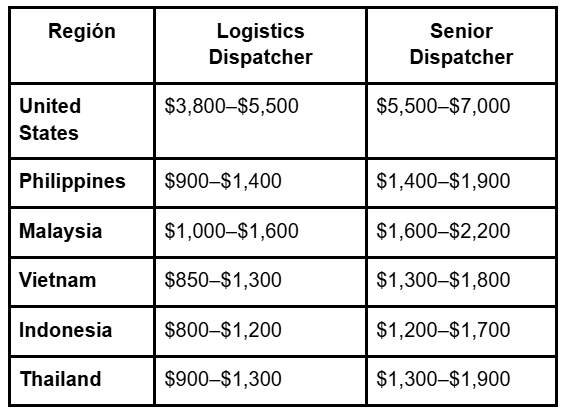
Average savings: 45–60% for skill-equivalent roles.
See regional strengths in The Best Southeast Asian Countries for Logistics Dispatchers.
Skill & Output Comparison (U.S. vs Southeast Asia)
Southeast Asia dispatchers are known for strong communication and structured execution.
Where SE Asia talent matches U.S. performance
- Routing efficiency
- ETA updates
- GPS monitoring
- TMS updates + documentation
- Customer + driver communication
- Escalation handling
- High call volume management
- Multi-shift reliability
Where U.S. talent may hold an edge
- In-person yard coordination
- Roles requiring U.S.-specific compliance
- Certain union or DOT-heavy workflows
For day-to-day tasks, see What a Logistics Dispatcher Actually Does.
Understanding Total Cost Beyond Salary
Salary is only one part of logistics coordination costs.
Additional cost contributors
- Payroll tax
- Benefits
- HR overhead
- Training + ramp-up
- Night shift differentials
- Replacement cost for turnover
Southeast Asia dispatchers reduce all of these dramatically.
ROI Modeling: The Full Financial Picture
Hiring from Southeast Asia often results in 2–3× operational efficiency ROI.
ROI drivers include
- Lower labor costs
- Faster response times (strong service culture)
- Higher documentation accuracy
- Reduced delivery failures
- Better customer communication
- Scalability for growth
Even onboarding two dispatchers from SE Asia often costs less than one U.S. dispatcher.
🚀 Book a Free Discovery Call to Hire Your Next Logistics Dispatcher
When to Hire a U.S.-Based Dispatcher Instead
Although SE Asia covers most dispatching needs, some roles require local presence.
U.S.-specific dispatcher scenarios
- Yard-based coordination
- Local pickup dispatching
- Physical load checks
- Roles tied to U.S. union/OTR requirements
- On-site quality assurance
For remote-capable dispatching, Southeast Asia remains ideal.
Which SE Asia Countries Offer the Best Salary-to-Performance Ratio?
Best picks by priority
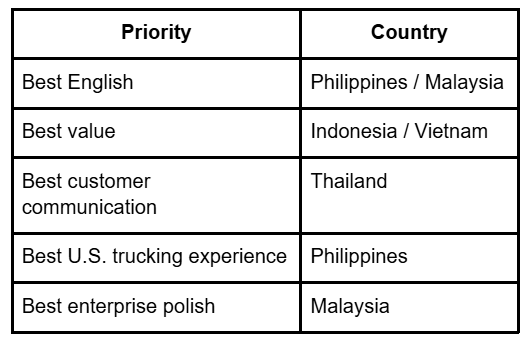
See full breakdown in The Best Southeast Asian Countries for Logistics Dispatchers.
💼 Hire Pre-Vetted Logistics Dispatchers from Our Talent Pool
FAQ
1. How much cheaper is a SE Asia dispatcher?
Typically 45–60% less than a U.S. dispatcher.
2. Are their skills comparable?
Yes — especially in communication, routing, GPS tracking, and TMS use.
3. Do SE Asia dispatchers work U.S. hours?
Yes — full-shift alignment is common.
4. What tools do they use?
TMS platforms, DAT, Truckstop, Samsara, Onfleet, GPS dashboards.
5. What regions in SE Asia are strongest for dispatchers?
Philippines, Malaysia, Vietnam, Indonesia, and Thailand.


.png)
