

U.S. vs MENA Operations Salary Comparison 2025: Cost Structures, Output Quality, and ROI Modeling
Business Operations roles in the U.S. have become increasingly expensive as companies demand stronger analytics, cross-functional coordination, reporting, and systems fluency. In 2025, many companies are hiring Business Operations Managers from MENA due to comparable skill quality at significantly more efficient salary levels.
This guide explains salary differences, output expectations, cost structures, and ROI modeling to help U.S. companies make high-leverage hiring decisions.
Interlinks included:
- How to Hire a Business Operations Manager from MENA
- The Top MENA Countries for Operations Talent
- What a Business Operations Manager Actually Does
- The 2025 Operations Skills Benchmark
Why U.S. Operations Salaries Keep Rising
Operations roles have expanded dramatically in scope. What used to be a coordination role is now a strategy–systems–analytics hybrid.
Factors driving U.S. salary inflation
- Advanced reporting requirements (GA4, Looker, SQL)
- Growth of remote-first teams needing better documentation
- Increased dependence on OKRs and structured planning
- Expanded RevOps responsibilities
- Higher expectations for technical literacy (Notion, Airtable, HubSpot, Salesforce)
This creates a talent shortage driving salaries upward.
U.S. vs MENA Salary Comparison (Monthly)
Mid-Level vs Senior Operations Talent
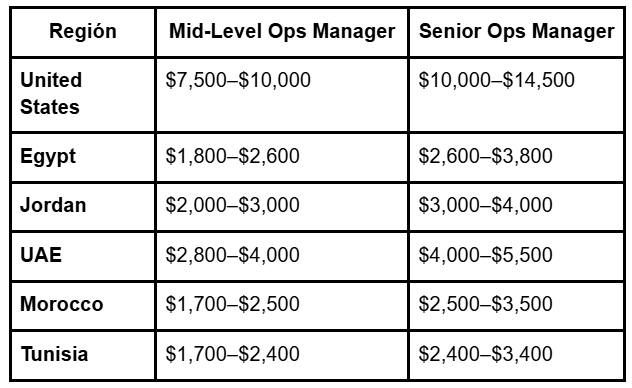
Cost savings: 40–55% vs. U.S. equivalents.
For country-specific skill traits, see The Top MENA Countries for Operations Talent.
Skill & Output Comparison (U.S. vs MENA)
MENA talent is highly competitive due to strong documentation habits, structured thinking, and tool literacy.
Where MENA talent matches U.S. output
- KPI dashboards
- Data analysis and forecasting
- Process design and SOP creation
- CRM/RevOps workflows
- Cross-team coordination
- Strategic planning & OKRs
- Systems building (Notion/Airtable)
Where U.S. talent may have an advantage
- In-person stakeholder management
- Senior roles requiring U.S.-specific compliance
- Roles needing deep SQL or financial modeling (varies by candidate)
For task breakdowns, see What a Business Operations Manager Actually Does.
Understanding Total Cost of Hiring
Salary is not the full story.
Additional cost elements
- Payroll tax
- Benefits
- HR overhead
- Software licenses
- Time-to-hire delays
- Replacement cost if a hire underperforms
With MENA operations talent, these burdens are significantly reduced.
ROI Modeling for Hiring a MENA Business Operations Manager
Strong Ops Managers produce measurable business efficiency gains.
Typical ROI improvements include
- 20–40% faster project execution
- 15–35% reduction in operational errors
- 20–50% better reporting accuracy
- Up to 3× increase in documentation quality
- Higher cross-team throughput
- Lower leadership time spent on coordination
When combined with 40–55% salary savings, ROI compounds rapidly.
🚀 Book a Free Discovery Call to Hire Your Next Business Operations Manager
When a U.S.-Based Operations Hire Still Makes Sense
Although MENA is ideal for most ops roles, certain scenarios lean U.S.-local:
U.S.-preferred situations
- Roles requiring heavy in-person collaboration
- Operations tied to U.S. legal/regulatory processes
- Executive operations + chief of staff roles needing physical presence
- Teams requiring synchronous full-time U.S. hours
These are exceptions not the norm.
Which Type of Operations Role is Best Hired from MENA?
Ideal roles for MENA-based hires
- Business Operations Manager
- RevOps Manager
- Systems & Process Manager
- Operations Coordinator
- Reporting & Analytics Ops
- Program Operations Manager
- Project Operations Manager
See skill frameworks in The 2025 Operations Skills Benchmark.
💼 Hire Pre-Vetted Business Operations Managers from Our Talent Pool
FAQ
1. How much cheaper is MENA operations talent?
Typically 40–55% less compared to U.S. salaries.
2. Is the skill level comparable?
Yes — MENA Ops Managers often match or exceed U.S. execution output.
3. Do MENA operations hires work U.S. hours?
Yes — there is strong overlap with EST/CST.
4. What tools are common?
Notion, Airtable, HubSpot, Salesforce, Asana, Monday, Looker.
5. Does lower cost mean lower quality?
No — salary differences reflect regional economics, not skill gaps.


.png)
